
Top Signs You Need Garage Door Service – Don’t Ignore These
The first real sign you need garage door service usually isn’t a loud bang. It’s a door that takes two seconds longer to open than it did six months ago. That lag is the sound of spring tension dropping, and left alone, that story tends to end with a broken spring at 6 a.m. on a workday with the car trapped inside. Most warning signs show up early and quiet, which is exactly why homeowners explain them away. If reading this makes you want a trained eye on your door, call (866) 937-9005 for a free estimate.
What follows isn’t the usual list of “it’s noisy, it’s old, it’s stuck.” These are the mechanical signals technicians look for, and the specific failure each one predicts. Recognizing them early is the difference between a small repair and a door that quits on a morning you can’t afford it.
Key Takeaways
- A measurable slowdown in door speed points to spring fatigue, not “getting old.”
- One side lifting higher than the other mid-travel is usually a cable problem, not a track problem.
- Roller noise and hinge noise are different sounds that tell you different things.
- Gaps at the bottom corners often mean a warped door section under stress.
- An opener that runs longer than usual is fighting a mechanical problem, not having an electrical one.
1. The Lag Test: Your Door Is Slowing Down
A healthy garage door opens and closes in a fairly consistent rhythm. When the cycle starts taking noticeably longer, the cause is almost always a spring losing tension, not a tired opener. Springs do the heavy lifting on your door. The opener just guides the door along. When the springs weaken, the motor has to work harder to compensate, and the whole cycle drags.
Here’s how to run what we call the lag test in your own driveway in Clinton. Pick a time when the house is quiet, open the door fully, and count in your head or on your phone while you watch. Then close it and count that cycle too. Do this once, then again in a month or two. You aren’t chasing an exact number; you’re watching for a change. If the door used to feel brisk and now feels sluggish, that shift is your cue.
Why does the slowdown matter? Because a spring under failing tension is a spring under load unevenly distributed. A spring already showing symptoms can snap during that extra work. A broken spring doesn’t just strand your car. It makes the door unsafe to operate by hand. When the lag test starts showing a clear slowdown, a technician can inspect the springs and cables while the door still works, which is a better place to be than a mid-cycle failure.
A safety note, straight up: garage door springs and cables are under extreme tension and are the most dangerous components on the door. We don’t recommend adjusting or replacing them yourself. That’s what garage door spring repair is for, and it’s one of the services we take most seriously.
2. Uneven Lifting Means a Cable Problem, Not a Track Problem
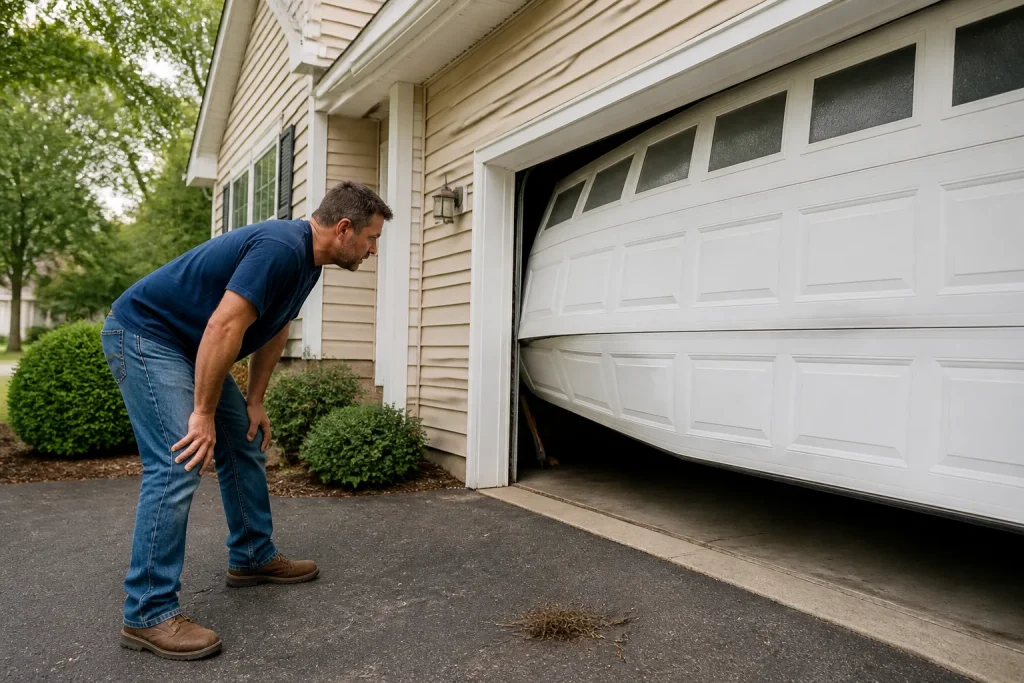
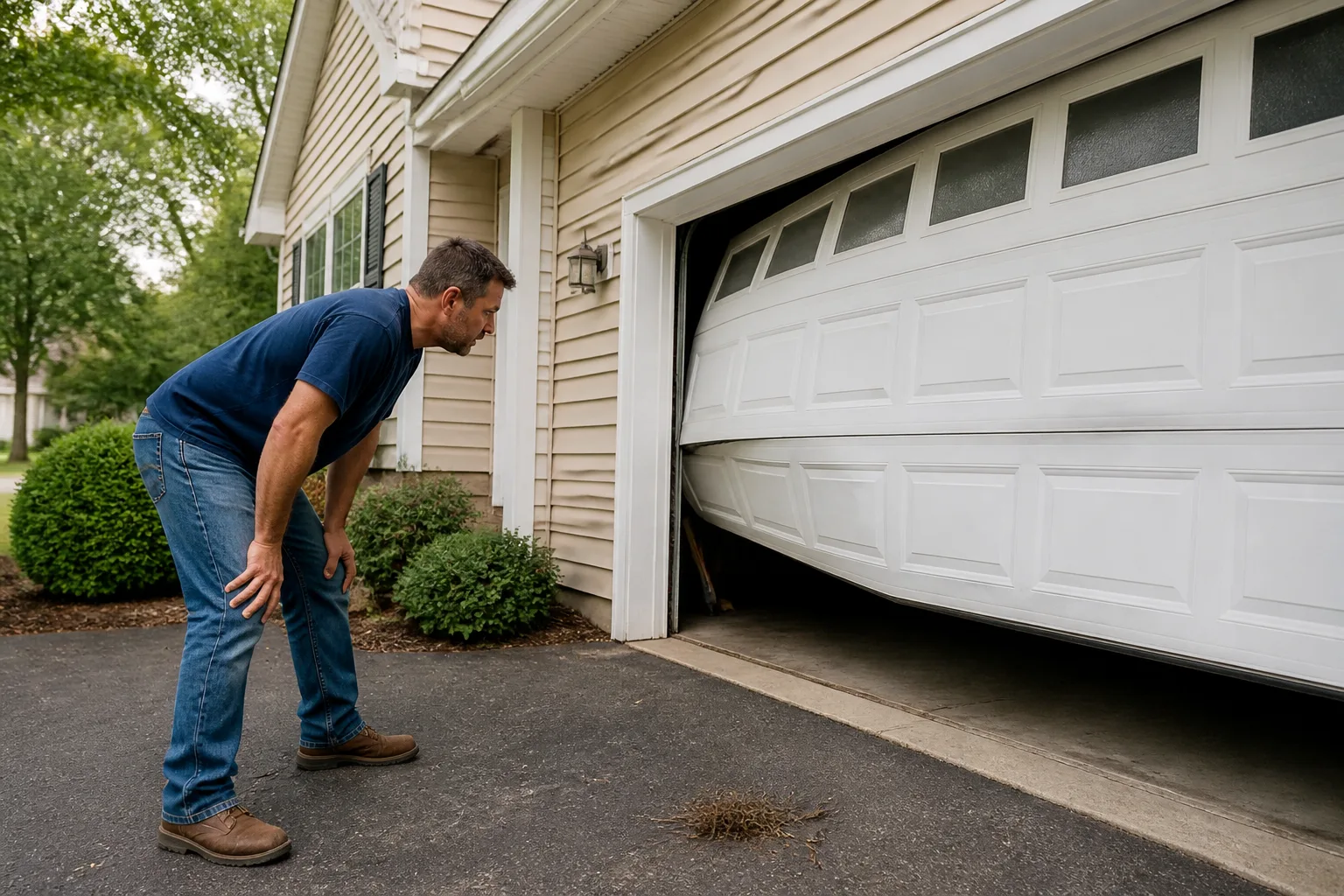
Watch your door as it travels up. If one side climbs faster than the other, if the door looks like it’s leaning mid-travel, or if one edge sits higher when it fully opens, you’re probably looking at a cable issue, not a bent track. This distinction matters a lot. Many homeowners assume the door is “off its track” and try to muscle it back into alignment. But an uneven lift usually points to a stretched, frayed, or slipping lift cable on one side, and the fix is a cable replacement, not a track adjustment.
Here’s why the two get confused. A cable losing tension lets one side of the door sag, and that sag can make the door rub against the track. The track catches the blame, but the cable started the problem. If you hear scraping or see the door binding on one side, don’t assume the track is bent. Look for the uneven lift first.
What an uneven lift predicts: if left alone, the door can bind and jam, the cable can snap, or the door can come off its rollers entirely. A jammed door with one side under tension is a genuine injury risk, so stop operating it manually and keep clear. This is one of the clearest signs you need garage door repair before the failure gets worse.
3. Diagnosing by Sound: Roller Noise vs. Hinge Noise
Doors talk, and the sound you hear tells a technician a lot before anyone touches the door. Two of the most common sounds come from two different parts, and treating them the same wastes time and money.
- Roller noise sounds like a steady squeal, a grinding hum, or a rolling rumble as the door moves. It’s usually worn, dry, or flat-spotted rollers, and it tends to follow the door the whole way up. New rollers or proper lubrication usually quiet it down.
- Hinge noise is more of a creak or a sharp crack at specific points in the travel, often near where the door panels connect. That’s a joint under stress, or a hinge that’s worn, loose, or seized. It’s a pinpoint sound, not a constant one.
There’s a third noise worth noting: a single loud pop or bang that comes from above the door. That often means a spring has failed, and you should stop using the door and call for service rather than keep testing it.
In our experience around Clinton, a lot of doors that “sound terrible” turn out to have a single bad roller that’s throwing off the rhythm. Others have a hinge quietly failing while the rollers are fine. Either way, matching the sound to the part is how a technician gets to the right fix fast. If the root of the problem is the motor instead of the hardware, that falls under garage door opener repair.
4. The Weatherseal Signal Most Homeowners Ignore
Walk outside and look at the bottom of your closed door, specifically the two bottom corners. A tight, even seal means the door is sitting square and the bottom section is sound. But if you can see daylight at one corner, or the weatherseal is lifting and curling at the ends, that’s a clue many people never connect to the door itself. Gaps at the corners often mean a bottom section is warped or under stress, and that usually traces back to something above it: a tired spring, a sagging cable, or panels that have gradually lost their alignment.
Why does a warped section matter? A door that’s no longer square flexes more with every cycle. That flex puts extra strain on the springs, cables, and hinges, which accelerates the very problems you’re already watching for. It also lets weather in. In a Maryland summer, that means humidity and moisture creeping past the seal; in winter, cold air and a door that struggles at the edges.
If the gap is small and central, a fresh weatherseal can solve it. If the gap is at the corners and the door looks uneven, get the door inspected before you replace the seal. Otherwise you’ll seal a problem that’s still twisting underneath. Doors from Clopay and Amarr, common in this area, are built to handle plenty of cycles, but no door tolerates being out of line for long.
5. When Your Opener Starts Working Too Hard
Here’s one that surprises people. An opener that runs longer than usual, struggles at the top or bottom of travel, or sometimes refuses to close all the way is usually not having an electrical problem. It’s working against a mechanical one. The motor is doing its job, but the door has gotten heavier to move: a spring losing tension, a tight hinge, a binding cable. The opener is telling you the door is stressed.
This matters because the easy mistake is to blame the opener and replace it. If the mechanics underneath are still struggling, a new opener inherits the same problem and works just as hard. That’s why we look at the whole door, not just the box on the ceiling, before recommending anything.
Modern openers make this easier to spot but also easier to misread. Wi-Fi and app-based units from brands like Genie, LiftMaster, and Chamberlain will often report “obstruction” errors or fail to complete a cycle when the real issue is resistance in the door itself. If your app keeps flagging a problem and the door looks fine, the door probably isn’t fine. That’s a strong sign it’s time for a closer look.
When to Call a Pro
Some signs you can watch at home. A slow door, a creaky hinge, a corner gap: those are worth monitoring and getting checked before they escalate. But a few things are never DIY, and we’d put them plainly: a door with a suspected broken spring, an uneven lift from a bad cable, or any door you can’t open by hand safely. Those are heavy, high-tension systems, and getting it wrong is how people get hurt.
We’re a garage-door-only specialist for exactly that reason. We work on the brand you already have, with fluency across Genie, Clopay, Amarr, Wayne Dalton, and others, so a technician arrives already knowing the quirks of your system. Our technicians have up to 10 years of experience, and spring repairs are something we treat as serious work, done right and done safely. When a door fails at a bad moment, we also offer emergency service for doors that compromise your home’s security or trap your vehicle. We answer 24/7, with fast dispatch from 7am to 7pm.
Related services in Clinton: for a closer look at what we do, see Clinton Garage Door Repair Pros.
The Bottom Line
The warnings that matter most are the quiet ones: a door that’s a beat slower, one side drifting higher, a sound that didn’t used to be there, a gap at the bottom corner, an opener running longer than it should. Each one predicts a specific failure, and each is cheaper to fix early. Watch your door for a month, run the lag test, listen to what it’s telling you, and get a trained eye on anything that keeps nagging.
If you’re in Clinton and need help, Clinton Garage Door Repair Pros offers free estimates. Every price is quoted and agreed before any work starts, so you’ll know the cost before a technician touches the door. Call (866) 937-9005. We answer 24/7. Fast dispatch from 7am to 7pm, Sunday through Friday.
Frequently Asked Questions
The most reliable early sign is a door that opens and closes more slowly than it used to, since weakening spring tension makes the whole cycle drag. Uneven lifting and a loud pop above the door are later warnings. If you suspect a failing spring, stop using the door and have it inspected, because springs are under extreme tension and are dangerous to handle yourself. Call (866) 937-9005 for a free estimate.
Usually not. A door that moves slower than it used to is typically fighting a mechanical issue like spring fatigue or a binding hinge, and the opener is just working harder to compensate. Replacing the opener without fixing the underlying resistance leaves the same problem in place. A technician can confirm what’s actually slowing the door. Call (866) 937-9005 to book an inspection.
It’s more often a cable problem. A cable losing tension lets one side sag, which makes the door rub the track and look “off track,” but the track is usually the symptom, not the cause. If your door lifts unevenly, stop operating it and get it checked before it jams or comes off its rollers. Call (866) 937-9005 for a free estimate.
Call as soon as you see a clear slowdown, uneven lifting, a fresh bang or pop, a diagonal corner gap, or an opener that keeps failing a cycle despite looking fine. Those are all signs of a mechanical problem that gets worse with use. If a spring or cable is suspect, don’t keep cycling the door. Call (866) 937-9005. We answer 24/7, with fast dispatch from 7am to 7pm, Sunday through Friday.
Written by the team at Clinton Garage Door Repair Pros.
Need Garage Door Help?
Call Clinton Garage Door Repair Pros - the local pro we connect you with is licensed and insured, here with fast help in Clinton.
(866) 937-9005